Place value is one of those things that seems simple – until you’re in the middle of a lesson and a student asks,
“Wait… is 41 the same as 14?”
We’ve all been there.
The confusion between tens and ones is real, and it can throw off everything from basic math facts to multi-digit addition.
That’s why I still reach for base ten blocks.
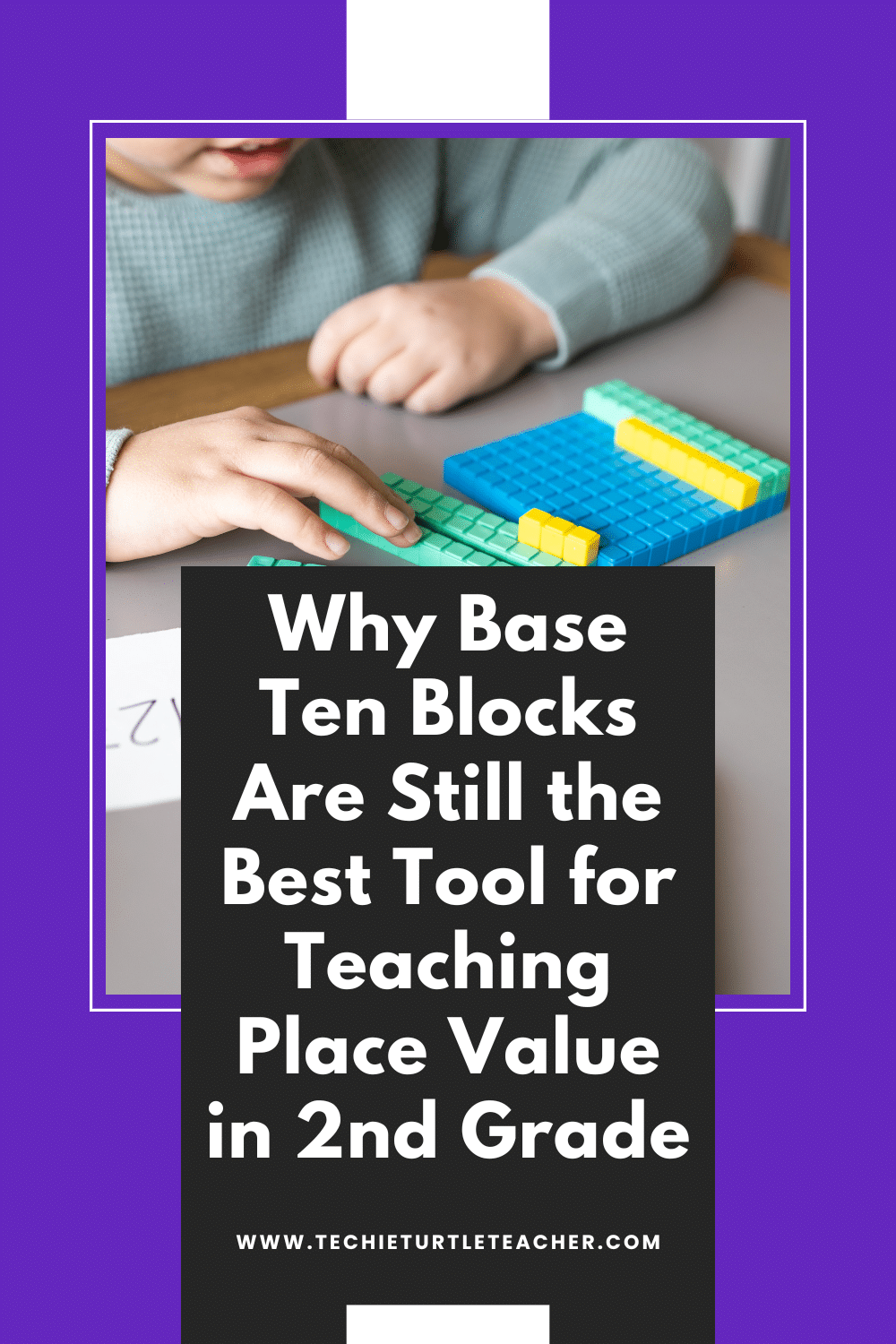
They’re hands-on, visual, and help students see how numbers are built.
Instead of just memorizing that 10 ones make a ten, they’re physically making that connection.
And that shift?
It changes everything for how they understand math.
(by the way – I dive deeper into tips like this in my weekly emails)
In this post, I’ll share why base ten blocks still have a place in today’s classroom.
Even if you’re not using manipulatives every day, they’re still a must.
You’ll also learn a few ways to make them easier to manage – especially when you’re teaching 2-digit addition and subtraction with regrouping.
Your students can absolutely master place value, and base ten blocks are exactly what you need.
Table of Contents
The Power of Base Ten Blocks for Place Value
If you’ve ever watched a student try to solve 47 + 25 and write “121,” you know just how important place value truly is.
Base ten blocks take the guesswork out of it.
They give students a way to build numbers instead of just looking at them on a page.
When they can physically count out 4 tens and 7 ones, and then add 2 more tens and 5 more ones, it clicks – you can see the lightbulb moment.
What’s even better is that students start to build number sense without even realizing it.
They begin to notice that ten ones can be traded for a ten, or that regrouping doesn’t mean starting over – it just means organizing numbers differently.
For visual and hands-on learners (which, let’s be honest, is basically everyone), base ten blocks give them something concrete to hold onto when everything else feels abstract.
And once they get the hang of it?
Their confidence goes up, their mistakes go down, and suddenly, addition and subtraction don’t feel quite so scary anymore.
Why Base Ten Blocks Are a Must for Addition & Subtraction
When students try to add or subtract multi-digit numbers and the digits aren’t lined up correctly… it’s basically math chaos.
We’ve all seen it – tens mixed in with ones, numbers drifting across the page, and no clear understanding of what’s actually being added.
And even if they do get the right answer by some miracle?
They often can’t explain why.

That’s where base ten blocks come in.
They don’t just help with solving problems – they help with understanding.
When students build numbers with base ten blocks, they see that each digit has a specific place and purpose.
The “4” in 47 isn’t just a 4 – it’s four tens.
And when they have to regroup, they see that ten ones really do equal one ten.
This hands-on experience lays the groundwork for solving problems on paper later.
It helps students slow down, make sense of what’s happening, and stop guessing.
And for your messy mathematicians?
It gives them structure.
It gives them a visual anchor.
And it helps them start recognizing patterns and place value rules that they can carry over into written work.
Base ten blocks don’t just support math skills – they build math thinkers.
The Problem With Base Ten Blocks, “They Take Too Long!”
As much as we love base ten blocks, they can feel like a lot.
Dragging out the tub of manipulatives.
Passing them out.
Picking them up off the floor. (Because let’s be honest, they always end up on the floor.)
And then there’s the time it takes for students to draw every single stick and dot on their paper… only for it to turn into a jumbled mess.
It’s no wonder some students – and teachers – get frustrated and rush through it.
I get it. I’ve been there.
But here’s the thing: when we skip the visual step too soon, students lose out on truly understanding how numbers work.
If they don’t get why regrouping happens or what place each digit belongs in, they’re more likely to make mistakes later – and those mistakes snowball fast.
That doesn’t mean you need to ditch base ten blocks altogether.
just means we need a smarter, more streamlined way to use them… without sacrificing the visual structure that helps students stay organized and actually understand what they’re doing.
Spoiler alert: that’s exactly what the next section is all about.
A Time-Saving Alternative (That Still Builds Understanding)
If your students are struggling with place value and getting their digits all over the place, you don’t have to choose between no visuals or drawing a hundred tiny blocks per problem.
There’s a happy medium – structured worksheets that guide students through base ten thinking without all the extra mess.
Instead of starting from scratch with every single problem, you can use printables that have space for students to draw quick sticks and dots in organized boxes, or even better – worksheets that already have tens and ones boxes built in.
This gives your students the chance to focus on what actually matters:
- Lining up their work
- Understanding place value
- Seeing the regrouping process
No more floating numbers or smooshed-together equations. Just clean, visual, organized math.
These kinds of supports are especially helpful when you’re transitioning from hands-on base ten blocks to pencil-and-paper strategies.
They act as a bridge, helping your students carry that visual understanding into their written work.
And if you’re thinking, “Okay, but I don’t have time to make all that…”
You don’t have to.
I’ve got a resource that does all of this for you (we’ll get to that in just a sec).
(but in case you’re in a rush, here it is)
A Classroom-Friendly Way to Practice

Once your students understand the concept of base ten blocks, the next step is giving them lots of low-stress practice. That’s where this printable pack comes in.
It includes:
- 16 worksheets covering 2-digit addition and subtraction
- Problems both with and without regrouping
- 6 exit tickets (with 2 problems per ticket to save time and paper)
Everything’s laid out in a way that helps students stay organized. They can draw sticks and dots in neat rows, work inside structured boxes, and focus on the math—not the mess.
This resource is flexible, so you can use it however it fits into your week:
- Slip a few into your math centers for independent or partner practice
- Send them home as no-prep homework
- Leave a set for a sub day—the directions are clear and the pages stand on their own
- Use the exit tickets as a quick check-in at the end of your lesson
It’s all aligned to 2.NBT.5, and best of all—you won’t need to scramble for extra practice pages or stay late at school trying to come up with last-minute review activities.
It’s already done for you. Just print and go.
Build Place Value Confidence Without the Overwhelm
If your students are anything like mine, they’re not trying to be careless — they just don’t see the difference between the tens place and the ones place yet.
They’re still figuring it out. And that’s exactly why base ten blocks matter.
We’re not just helping them get the right answer — we’re helping them understand why the answer makes sense. And honestly? That’s way more important.
But I also get it — you don’t always have time to pass out manipulatives, manage cleanup, and guide every student through building every single number. That’s where structured visuals and clear practice pages come in clutch.
They give your students the support they need to line things up correctly, practice regrouping, and actually think about what the numbers mean — without slowing down your whole math block.
So if you’ve got a handful of students (or let’s be real, more than a handful) who are still mixing up place value or stacking their digits all over the page, this pack is going to save you time and stress.
➤ Click here to grab it now and take one more thing off your lesson planning list.
Because teaching math doesn’t have to be perfect. It just has to make sense to your kids — and this is one easy step in that direction.
Pin this to Pinterest for later